When the Chalk Train Derailed: Three Weeks That Killed 14,266 Survivor Entries
September 2024 took Circa Survivor from 14,266 entries to 642 in three weeks; Thanksgiving 2025 took it from 898 to 49 in four days. The collapses by the numbers, and the breakeven grid that prices a fade.
Survivor pools die in clusters. Nobody gets eliminated on a quiet Sunday in October — they die when the whole country picks the same team and the same team loses. Two stretches in the last two seasons taught the format more than any strategy column: September 2024, when Circa's $20 million contest lost 95.5% of its field in three weeks, and Thanksgiving 2025, when three favorites lost over four days and the 49 survivors who dodged them watched their implied value multiply roughly 18 times.
This is the field-collapse story, and the math that explains it.
September 2024: the fastest collapse on record
Circa Survivor opened 2024 with 14,266 entries at $1,000 each. Week 1, the Patriots beat the Bengals as home underdogs and took 34.3% of the field out with them. Week 2 dropped the count from 8,702 to 3,877. By the end of Week 3, 642 entries remained — 4.5% of the starting field. ESPN's free parallel contest lost 94.5% of its million-plus entries in the same span.
The detail worth keeping: the eight eventual champions largely survived that stretch by being off the popular teams, saving their good teams for the thin December board. The wreck wasn't a fluke that punished everyone equally. It punished concentration.
Thanksgiving 2025: the definitive derailment
A year later, with 898 entries alive, ownership concentrated onto a short holiday slate to an almost absurd degree. The Eagles were on 54.3% of remaining entries. The Ravens were on 29.9%. The Chiefs were on 8.7%. That's 92.9% of the field riding three teams.
All three lost. The Bears beat the Eagles 24-15 on Black Friday. The Bengals beat the Ravens 32-14 on Thanksgiving night. Dallas beat Kansas City. 849 entries died in four days; 49 survived. The two holiday underdogs' combined moneyline odds were +7,765.
Here's the number that matters. Entering the week, each live entry carried about $20,844 of implied value. After the dust settled, each survivor's implied value was $381,998 — an 18-fold increase in four days. No single-week edge in existence compounds like a chalk-train wreck you sidestepped. The same leg ended Circa's $100,000-entry Grandissimo outright: all six remaining entries were on Philadelphia or Baltimore, so the contest terminated with a six-way, $1.15 million each.
Why concentration is fragility, not safety
The ownership-amplification mechanic does two things at once, and both are bad for the crowd.
If the chalk wins, a 50%-owned winner advances half the field. You spent a week of your finite 18-week runway to tread water. Your position barely moved.
If the chalk loses, half the field dies at once — and every ticket not on the train gets more valuable. Concentration doesn't make the favorite safer for the people riding it. It makes the outcome more polarizing, and polarity is only your friend if you're holding the less-crowded side.
This is also why "contrarian for its own sake" is its own disease. In Weeks 11–12 of that same 2025 season, the five most-selected teams all won two weeks running; Week 12 eliminated 39 entries. Chalk holding serve is the modal outcome. Fading is a priced decision, not a personality trait.
The breakeven grid
The fade question has a concrete answer: how much win probability can you sacrifice and still break even on equity? In a 1,000-entry pool with the non-chalk field averaging 62% win probability, the budget looks like this:
| Chalk win prob ↓ / Ownership → | 10% | 25% | 40% | 55% | 70% |
|---|---|---|---|---|---|
| 65% | give up ≤ 3.8 pp | ≤ 10.3 pp | ≤ 17.7 pp | ≤ 26.5 pp | ≤ 36.9 pp |
| 70% | ≤ 3.6 pp | ≤ 9.7 pp | ≤ 17.0 pp | ≤ 26.0 pp | ≤ 37.0 pp |
| 75% | ≤ 3.2 pp | ≤ 8.9 pp | ≤ 15.9 pp | ≤ 24.7 pp | ≤ 36.3 pp |
| 80% | ≤ 2.8 pp | ≤ 7.8 pp | ≤ 14.1 pp | ≤ 22.6 pp | ≤ 34.3 pp |
| 85% | ≤ 2.2 pp | ≤ 6.3 pp | ≤ 11.8 pp | ≤ 19.3 pp | ≤ 30.6 pp |
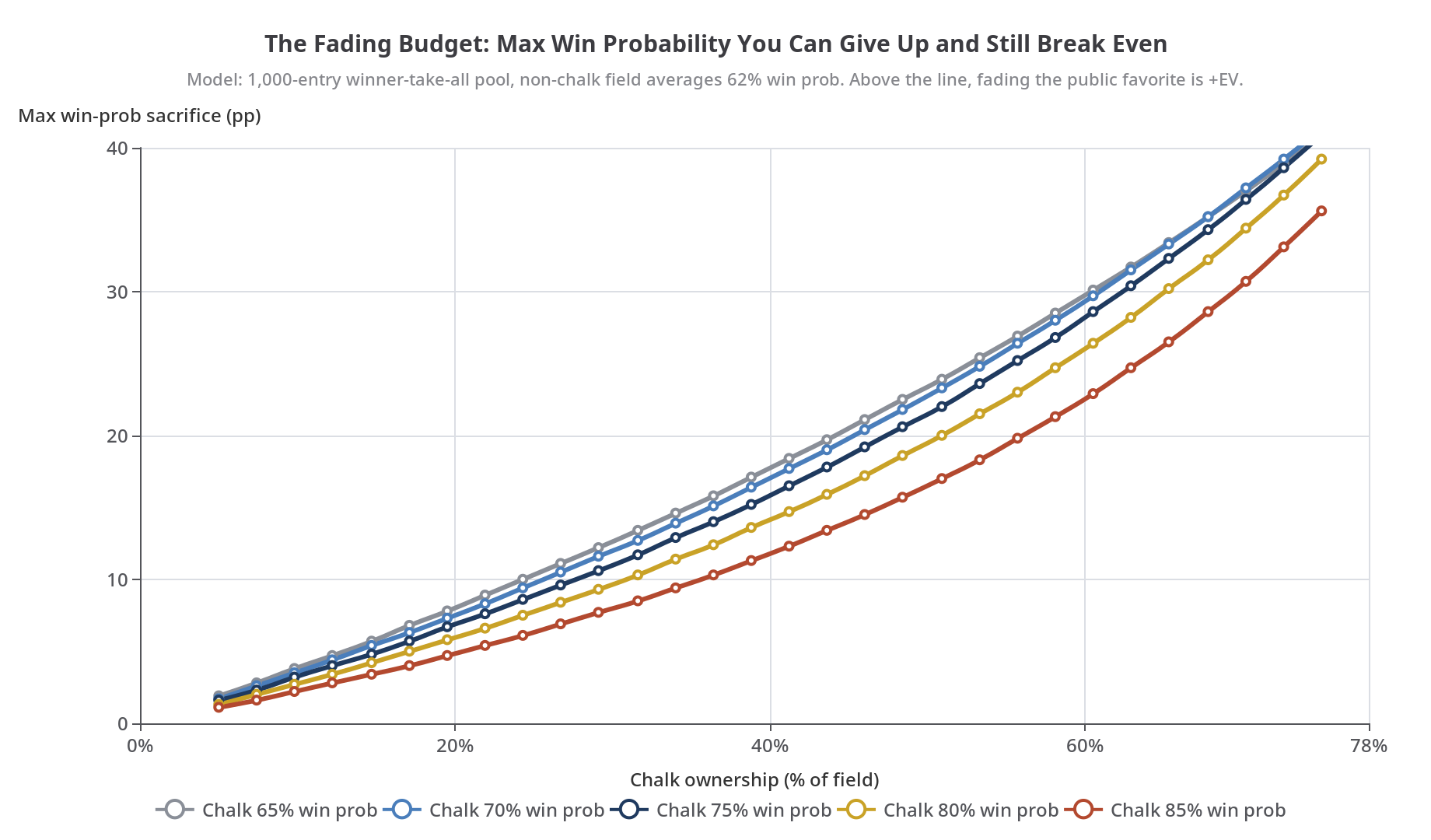
Read the table as a permission slip with strict limits. A 75% favorite owned by 10% of the field is almost unfadeable — you may give up only about three points, so ride it. That same 75% favorite owned by 55% can be faded for any alternative at 50% or better. Same team, same week, completely different decision. The ownership number is the strategy.
The rules that fall out
The math collapses into three working rules, and we're strict about all of them:
- Fade only within budget. If no available alternative clears the breakeven, ride the chalk without guilt. The table is the discipline, not nerve.
- Never blanket-fade. "Never take the big favorite" is wrong as often as "always take it." Both rules ignore the one input that decides everything: how crowded the train is.
- Never blanket-ride. A 70%-owned favorite isn't a safe pick; it's a coin flip on whether half the field advances or dies. Choose it only when the breakeven grid says you've got no better choice — and in holiday legs and bye-heavy weeks, when ownership concentrates hardest, check the fade side first.
Fourteen thousand people had a plan in September 2024. It was the same plan. That's the problem.