The DraftKings Main Event Is a Portfolio Game Wearing a Survivor Costume
The DraftKings Main Event sells $100 entries, 150 per person max. That turns its NFL survivor pool into a portfolio game: differentiation, correlation caps, and the chop math of being your own field.
DraftKings will happily sell you one entry into its Main Event NFL Survivor Pool for $100. It will also sell you 150. That second number matters more than the first, because it changes what kind of contest this is.
The headline terms: $100 entry, up to 150 entries per person, a $1.5 million guarantee (DraftKings). In 2024 it drew 18,515 entries and a $1,666,350 pool — the guarantee cleared, then some (TeamRankings). Winner-take-all, or an equal split if multiple entries survive. Two rule quirks worth knowing: ties count as wins at DraftKings (Circa grades them as losses), and the house rake runs roughly 5% on big buy-ins, up to 15% at the micro level (BettingUSA).
Why 150 entries changes the math
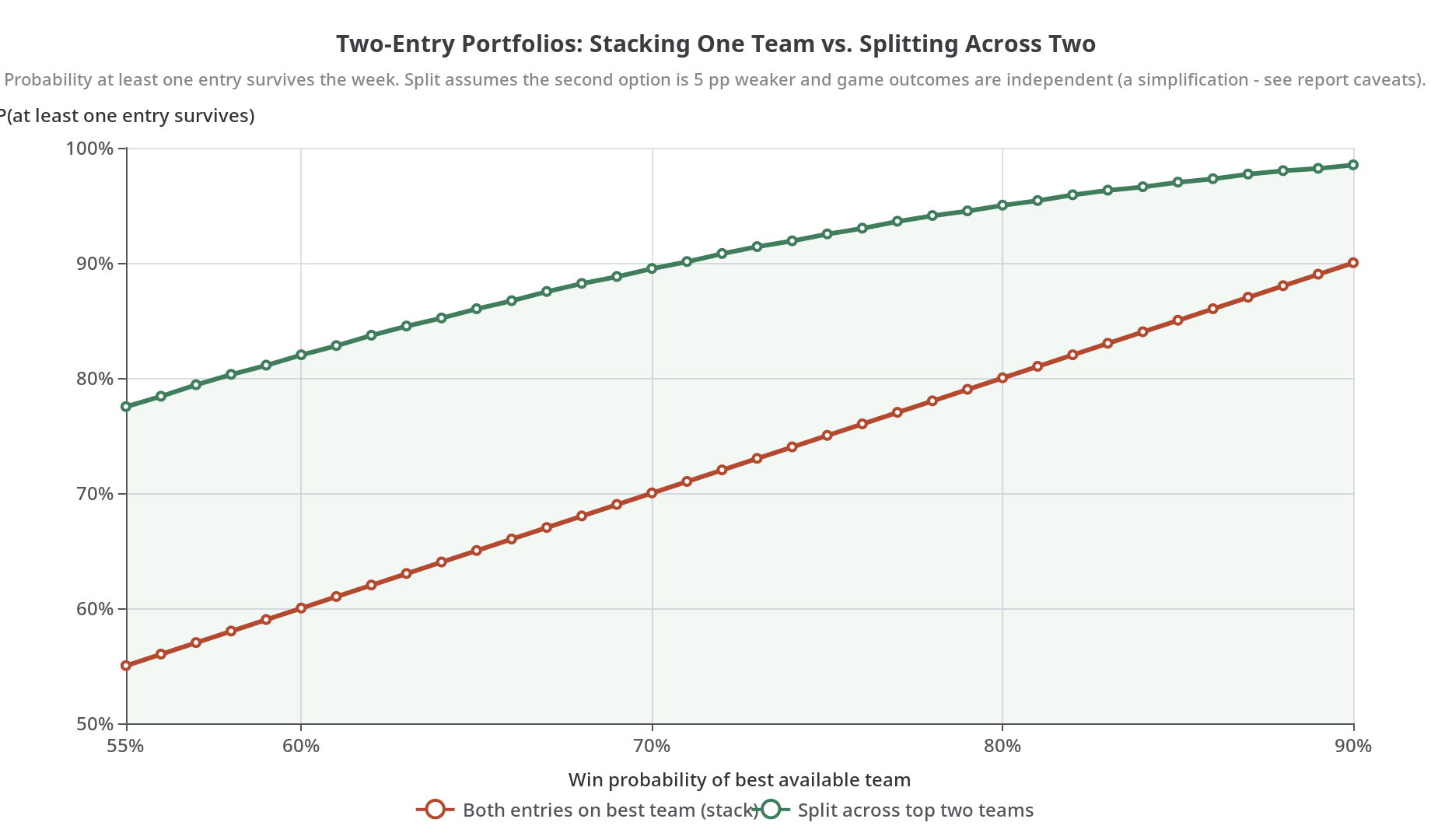
A single survivor entry is a fragile instrument: one 15% tail event ends it, and no amount of skill changes the variance of a Bernoulli chain. Multiple entries convert the game from a bet into a portfolio. Two entries on different 70% teams survive the week at 91%; three at 97.3%. That buffer compounds into a much better chance of having at least one entry deep in January — the only thing that pays in a top-heavy structure.
But there's a catch, and it's the one that separates portfolio players from people who bought a lottery strip: the entries only help if they're genuinely differentiated. Ten identical entries are one entry with ten times the fees. Five entries that "feel diversified" often share two or three identical picks in the early chalk weeks — exactly where wipeouts happen. Correlation is the silent killer.
Split, stack, or hedge
Three architectures cover the design space:
- Full split — every entry takes a different team every week. Maximum weekly survival; harvests any wipeout. But it burns teams two to four times as fast and strands entries on a thin December board.
- Chalk-and-hedge — most of the portfolio rides the week's best equity line, a minority (think one of three) takes the top +EV fade. The workhorse: a permanent leveraged ticket against the chalk trains while staying alive on the favorites.
- Path-stacked pods — entries grouped into two or three pods, each on a coherent long-run plan with different teams reserved. Best future-value preservation, real planning burden.
Whatever the architecture, the discipline is the same: plan the portfolio's picks jointly, week by week, and cap any single team at roughly 50% of the portfolio. The point isn't to guess which game loses — it's to guarantee no one game outcome kills more than half your position. In the 2025 Circa Thanksgiving leg, a three-entry portfolio with two entries on the Eagles/Ravens consensus and one on a 60–65% alternative lost two and kept one; an undifferentiated three-chalk portfolio lost everything (Yahoo Sports).
One subtlety deep in the contest: when your entries are a meaningful share of who's left, your entries become the field. Splitting three surviving entries across two teams guarantees you lose one if either loses. Sometimes concentration is correct; sometimes splitting is. Do the chop math with your own entries counted before choosing.
Not your office pool
The strategy that wins a one-entry office pool will get you slowly buried here. In a 40-person pool, survival-first play dominates: take the safest team, let coworkers eliminate themselves on narrative, and don't spend future value on leverage the pool will never live long enough to cash.
An 18,515-entry Main Event is a different animal. Pure chalk is a slow death — some opponent will run hot on contrarian picks, and a no-risk path has almost no chance of producing the outlier season a five-figure field demands. You need planned leverage spots, and you need to accept that equity math — win probability times leverage against the field — outranks raw safety more often than feels comfortable.
And a word on bankroll, because the fee schedule invites overreach: maxing 150 entries is a $15,000 position. The marginal value of entries is steeply diminishing — one to two is transformative; four to five adds little survival probability at full cost. Portfolio play reduces variance; it does not manufacture edge, and expected value per dollar does not rise with entry count. Most serious players we respect run a handful of entries, not a suitcase.
The small-ball tier
Below the Main Event sits a ladder worth climbing: the Mini at $10, the Micro at $1, and a free pool with a $30,000 prize that drew 251,059 entries (The Lines). These pay fixed prizes regardless of field size, which flips the strategy dial hard toward pure contrarian leverage. When a quarter-million people each hold one entry, riding the week's chalk means surviving alongside a small city's worth of competition; the only path to a meaningful share of a fixed prize is to be somewhere else when the favorite loses. Zero rake, zero entry cost — enter all of them, treat them as lottery tickets with a skill overlay, and size your expectations accordingly. The expected value is real. So is the near-certainty that any given entry dies.
DraftKings built the one survivor contest where the roster construction is the skill. The football is almost beside the point.
Next up: the contest guide to Circa's $20 million monster, where the pick distribution is public, the ties kill you, and 90% of the field uses a proxy.