The Five Leaks That Kill Survivor Entries (and the One Habit That Catches All of Them)
Five named leaks that quietly bleed survivor equity — chalk worship, hoarding teams, ignoring the tie rule, revenge bets, and copying champions' highlights — and the weekly decision log that catches all of them.
Most survivor equity isn't lost to bad luck. It's lost to a short list of named errors, each with a procedural fix that takes minutes. We're publishing the list now, so when we violate one in November you can quote it back at us.
Leak 1: The big-favorite trap
What it looks like: You take the week's biggest favorite, every week, because the biggest favorite is the safest team. It's the most common way to play survivor, which is why it's the most expensive.
Why it costs equity: Riding chalk converts a strategy game into a lottery on favorites' coin flips. If 70% of the field is on your team, the alternative doesn't need to be good — it needs to clear only ~36% win probability to be worth more equity. Against a 40% chalk, the bar is about 66% — and in September the board is full of 60-something-percent teams nobody's talking about. The crowd never computes the breakeven; that's the edge.
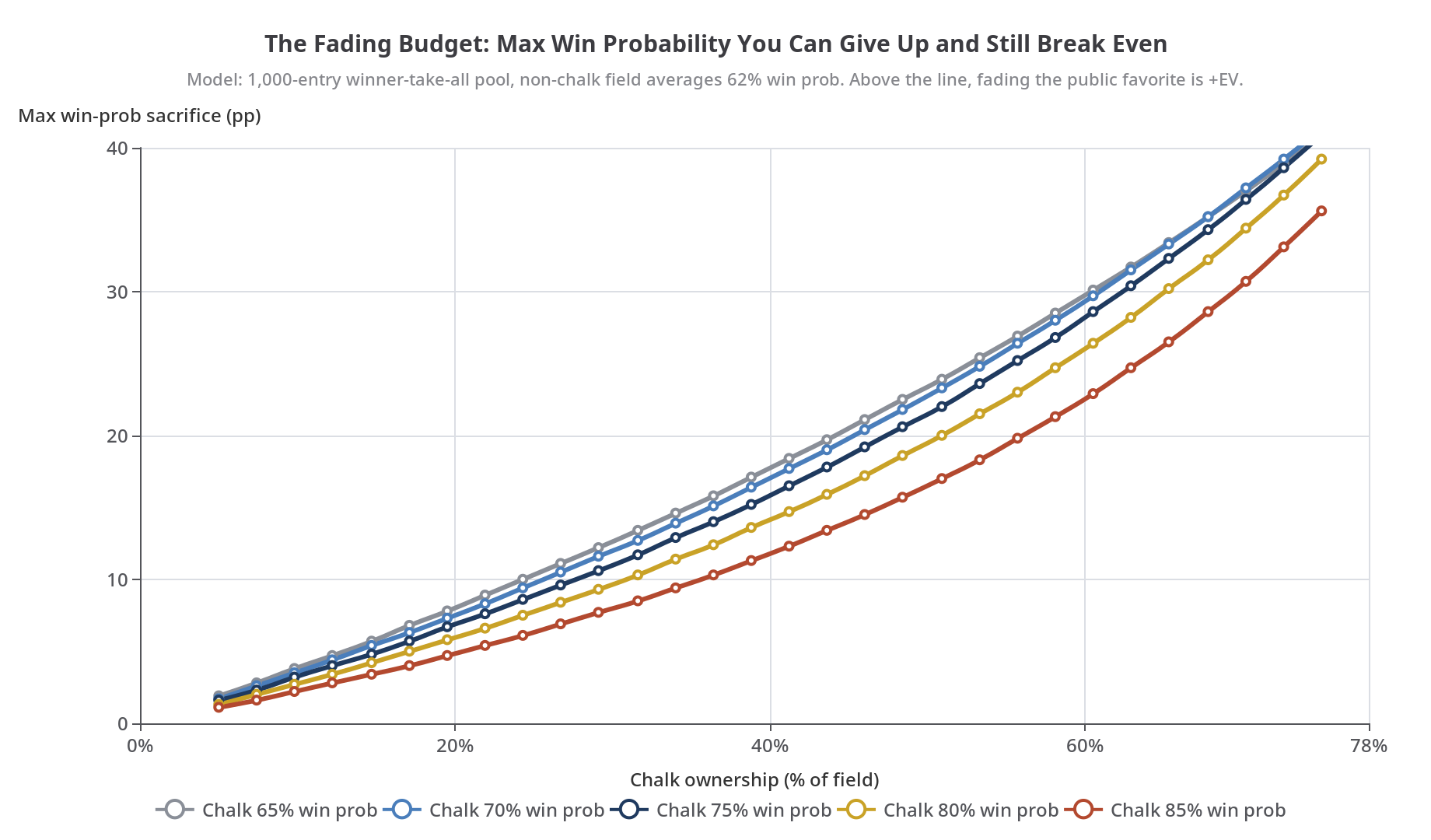
The fix: Compute the week's fade breakeven before forming an opinion. Ride the chalk only when no alternative clears the number.
Leak 2: Saving teams too long (and its mirror, spending them too fast)
What it looks like: Two opposite failures. The myope burns the Chiefs in Week 3, then faces a December board of coin flips. The hoarder refuses to spend anyone all fall, and dies anyway when the saved teams get worse.
Why it costs equity: Myopia produces the dramatic wipeout; hoarding produces a slow starvation that's invisible week to week and obvious in every autopsy. Both optimize one week instead of the season. Across 12 seasons of data, rolling eight-week lookahead planning beat both week-to-week improvisation and a rigid full-season map. A team saved for December is not owed to you — if its quarterback tears an ACL in Week 10, you re-optimize; you don't grieve.
The fix: Maintain a living eight-week lookahead, re-solved weekly — not carved in stone, not improvised.
Leak 3: Ignoring the tie rule
What it looks like: You never read the fine print. Most major contests — Circa and DraftKings included — count a tie as an elimination, same as a loss. Some social pools let ties survive; players who don't know which rule they're playing under are calibrated for the wrong game.
Why it costs equity: Ties are rare, but over 18+ legs the tail risk adds up. In a contest where ties kill, a pick in a tightly-lined game is quietly worse than its win probability suggests. Nobody thinks about ties until one ends their season, at which point thinking is no longer available.
The fix: Read the rules in August. If ties kill, shade away from tightly-lined games when alternatives exist.
Leak 4: Emotional recovery bets — "they burned me" and "they're due"
What it looks like: Your fade lost in Week 7, so in Week 8 you ride chalk to feel safe. Or the Packers knocked you out in 2023, so you'll never pick the Packers again. Or a team lost three straight and is "due."
Why it costs equity: Variance owes no one an apology or a makeup game. A team's past results against your entries carry zero information about its next game, and "due" is gambler's fallacy wearing a jersey. The measurable version is the whiplash from chalk passenger to chronic contrarian: resolve a wipeout by changing identities and you bleed equity in both directions. It's the crowd's default too — public picks concentrate on the most obvious favorite with a reliability only herd psychology explains.
The fix: Pre-commit Thursday's pick in numbers; change it only on verified news, never on feeling.
Leak 5: Worshipping winners
What it looks like: Every champion's story features one dramatic fade, so you copy dramatic fades. The current exemplar: the 2025 co-winners' Bears play at 27.1% win probability on Black Friday, retold in every write-up of the event. What the retellings omit is that the play carried about 0.55x chalk equity ex ante — for every champion it crowned, dozens of identical gambles died anonymously the same weekend.
Why it costs equity: This is survivorship bias with a trophy. The flashy pick was the variance, not the edge. What wins championships is the boring infrastructure — team-saving discipline, pre-planned holiday legs, the willingness to ride chalk when the breakeven said ride.
The fix: Study winners' processes and losers' decisions. The format is engineered to make you do the reverse.
The decision log: the only honest scorecard
Every leak shares one root cause: decisions made in the emotional domain instead of the numerical one. The countermeasure is one habit — a written decision log, kept weekly, recording four things before kickoff: the market win probabilities for your candidates, your ownership estimate for the field's pick, the week's fade breakeven, and the pick with a one-sentence rationale.
Ten minutes a week. It's the only scorecard that means anything in a format where even excellent play finishes first perhaps one season in fifty, and the season outcome is maybe 70% luck and 30% skill. Judged weekly by results, every player looks like a genius in October and an idiot by Christmas — sometimes in the same month. Judged by the log, the only question is whether your decisions beat the alternatives available at the time. The log is honest when you're not.
Write the numbers down before kickoff. The entry will lie to you about how it died; the log won't.